-
Email queenie@hellounipack.com
-
WhatsApp +8619807883476

How to Choose Custom Coffee Packaging: Bag Styles, Materials & Valves
If you’re wondering how to choose coffee packaging for your brand, start with the coffee itself—not the artwork. Whole beans, ground coffee and instant coffee have different packing and handling needs. The right bag also has to work with your filling process, sales channel and customer experience.
This guide compares common coffee bag styles, explains when valves and zippers are useful, and shows what to check before requesting a custom packaging quote.
1. How to Choose Coffee Packaging for Your Product
Start by answering three questions: what is inside the pack, how will it be filled, and where will it be sold?
- Freshly roasted whole beans: Consider the expected release of carbon dioxide after roasting, your planned roast-to-pack interval and how the bag will be sealed.
- Ground coffee: Review oxygen and moisture protection, the required fill volume and how customers will store the product after opening.
- Instant coffee: Single-serve portions call for a different format from a resealable bag of roasted beans. Narrow stick packs may be suitable when each portion will be opened and used once.
The sales channel matters too. A retail pouch needs clear front-facing information and dependable shelf presentation. A wholesale pack may prioritize handling and filling efficiency, while an online brand should test how the filled package fits its shipping cartons.
For example, UNIPACK’s custom coffee powder stick packs illustrate a single-serve format for instant coffee. That format makes sense for portioned powder, but it should not be treated as a substitute for a larger whole-bean bag.
2. Compare Coffee Bag Styles Before Choosing a Material
The bag shape affects how a product stands, how much space it provides for branding, and how it passes through filling and sealing equipment. It does not determine barrier performance by itself.
| Coffee packaging format | When it may be useful | What to verify |
|---|---|---|
| Flat-bottom bag | Retail coffee that needs a structured, upright presentation | Filled stability, bottom depth, closure and valve placement |
| Stand-up pouch | Flexible retail ranges with several blends or pack sizes | Bottom gusset, zipper fit, opening and fill dimensions |
| Side-gusset bag | Traditional coffee packaging or certain larger packs | Sealing method, filled shape and equipment compatibility |
| Stick pack / sachet | Instant coffee portions and selected samples | Dose size, seal integrity and tear-open experience |
For a closer look at bottom geometry, shelf presentation and filling-line considerations, see our detailed guide to flat-bottom vs stand-up coffee bags.
Flat-bottom bags: a structured retail format
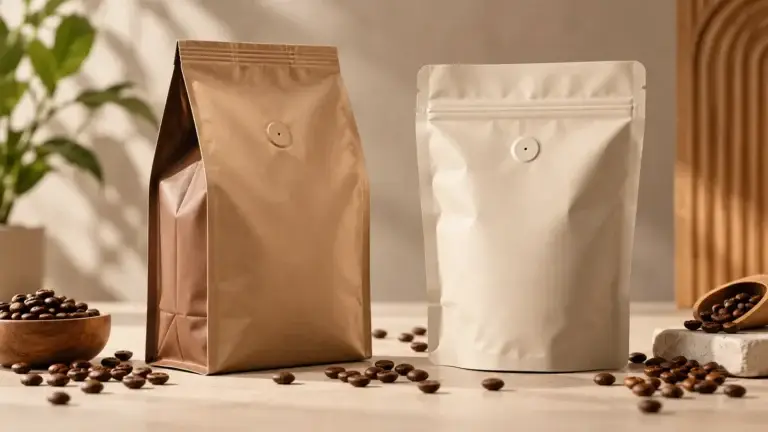
Flat-bottom bags provide a defined base and multiple printable panels. They are worth considering when shelf presentation and standing stability are priorities. For a visual example, see these custom flat-bottom coffee bags. The actual size and construction still need testing with your coffee.

Stand-up pouches: a flexible alternative
Stand-up pouches use a bottom gusset to create a standing pack. They can be convenient for a product range with different blends or sizes, especially when a zipper is useful after opening. UNIPACK’s self-standing coffee pouches provide a product example and customization options; confirm the precise bottom construction on a sample.

A folding carton may also be useful for a gift set or multipack, but a standard paperboard box is generally secondary packaging. It does not automatically replace the protective seal and barrier of the inner coffee pack.
3. Choose Coffee Packaging Materials for the Protection Required
Oxygen, moisture, aroma retention and distribution conditions should guide the material discussion. Common laminate structures shown on UNIPACK’s coffee product pages include PET/PE, PET/VMPET/PE and PET/AL/PE. They are options to evaluate, not universal solutions.
- PET/PE: Suitability depends on the film specification and the finished pack’s required protection.
- PET/VMPET/PE: Adds a metallized layer; confirm actual barrier and sealing specifications rather than relying on the material name.
- PET/AL/PE: Includes an aluminum-foil layer and may be considered when stronger barrier protection is required, subject to finished-package testing.
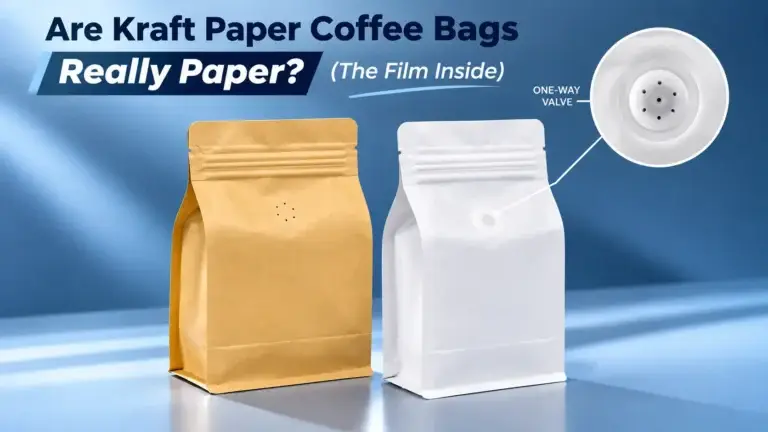
A kraft-paper appearance is not proof of a particular barrier level or recyclability. Ask suppliers for the proposed full structure, thickness, seal requirements and relevant barrier test information. Validate any shelf-life target using the real coffee and expected storage conditions.
If two suppliers propose different film structures, ask them to explain the trade-offs in clear terms: what problem each layer is intended to solve, what data supports the proposed protection level, and whether the material can be sealed on your equipment. Finished-pack integrity matters as much as the theoretical properties of the film. This is especially important when comparing a visually similar paper-look pack with a high-barrier laminate.
If the pack will be sold in the EU, also check applicable food-contact requirements. The European Commission’s food-contact materials legislation provides a starting point; the final material and compliance documentation must be checked for the destination market.
4. Do You Need a Degassing Valve or Resealable Zipper?
When a one-way degassing valve can help
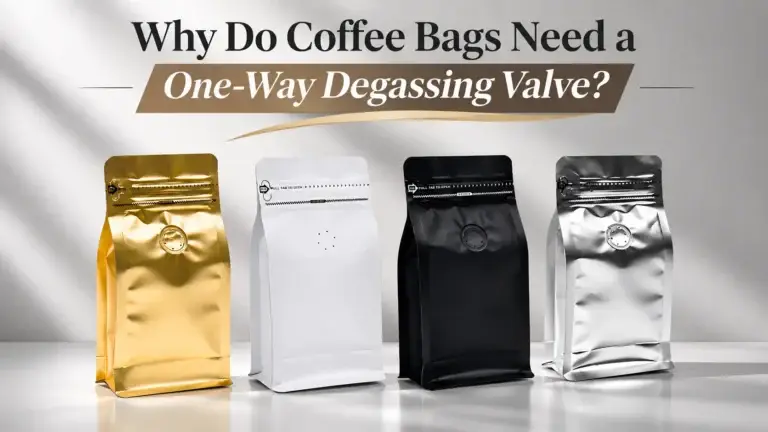
Freshly roasted coffee can continue releasing carbon dioxide after packing. A properly specified one-way valve allows gas to escape while helping limit air entering through the valve. Whether you need one depends on the product, roast-to-pack timing and packing process—not on a blanket rule that every coffee bag needs a valve.
For instance, UNIPACK’s flat-bottom coffee bags with a one-way valve show how the feature can be incorporated into a roasted-coffee pouch. Confirm valve location, laminate and seal performance before production.

For a closer look at valve operation, placement and specification requirements, read our guide to one-way degassing valves for coffee bags.
When a zipper is useful
A resealable zipper can improve convenience for coffee that customers open repeatedly. It is less relevant to a single-use sachet. Because zippers take up space near the top seal, check the fill level, opening experience and usable dimensions on a physical sample.
Neither a valve nor a zipper compensates for unsuitable materials or poor sealing.
5. Test the Filled Bag Before Approving Printing
A stated net weight is not enough to choose pouch dimensions. Bean size, roast level and grind affect how coffee occupies space. Test the actual product in a sample bag using the intended filling method.
Before ordering, check:
- Filled height, headspace and seal clearance
- Stability on the shelf and fit inside shipping cartons
- Valve, zipper and tear-notch positions
- Compatibility with manual or automatic filling equipment
- Artwork visibility after filling, folding and sealing
For printed bags, reserve space for the legally required label information in each destination market, product identification, barcodes and any variable data. Confirm print proofs and filled samples before approving a production run.
A practical way to evaluate suppliers is to request two or three packaging options built around the same fill weight and use case, then compare their structure, features and sample performance. Ask which parts of the proposed specification are fixed and which can be adjusted after a fill trial. This keeps the conversation focused on a workable pack rather than simply comparing attractive mockups.
6. Coffee Packaging RFQ Checklist: 10 Details to Send a Supplier
A good request for quotation (RFQ) lets suppliers compare the same specification rather than guessing what you need. Include:
- Coffee type: Whole bean, ground, instant or another defined format.
- Net weight: Target fill per pack and any results from a physical fill test.
- Bag style: Flat-bottom, stand-up, side-gusset or stick pack.
- Dimensions: Preferred width, height and gusset, or a request for sizing advice.
- Protection target: Expected distribution conditions and any barrier requirements.
- Extras: Valve, zipper, tear notch or other features, if needed.
- Printing: Artwork status, number of designs, colors and finishes.
- Filling method: Manual or automated, including machine requirements.
- Order plan: Estimated quantity per design and destination market.
- Approval process: Samples, print proofs and any target delivery window.
If an item is undecided, write “supplier recommendation requested”. That is more useful than inventing a technical specification.
7. Common Mistakes When Choosing Coffee Bags
Selecting a bag only for its appearance. A polished design means little if the filled pouch stands poorly or cannot be sealed reliably.
Assuming one material suits every coffee format. Ground coffee, freshly roasted beans and instant powder may have different protection and filling requirements.
Adding valves or zippers automatically. Use these features when they solve a defined packaging or customer-use problem.
Comparing unlike quotations. Different film structures, quantities, accessories and printing requirements can make unit prices misleading. Compare matching specifications.
Frequently Asked Questions
Are flat-bottom bags better than stand-up pouches?
Not universally. Flat-bottom bags offer a structured shape, while stand-up pouches provide another flexible retail format. Compare filled samples, shelf presentation, sealing equipment and your budget before choosing.
Do all coffee bags need a one-way valve?
No. Valves can be useful when meaningful post-roast gas release is expected, but the decision depends on the coffee and packing process. Instant-coffee stick packs generally require a different packaging assessment.
How do I choose the right coffee bag size?
Start with the target net weight, then test the actual coffee in a candidate pouch. Verify filled dimensions, seal clearance, accessories and shipping fit before finalizing the specification.
Plan Your Custom Coffee Packaging Project
The best way to choose coffee packaging is to compare samples against your actual coffee, filling process and sales channel. Explore UNIPACK’s custom coffee packaging solutions for available formats, then share your requirements with the team using the RFQ checklist above. A clear brief makes it easier to discuss the right materials, dimensions and functional options for your project.
Looking for more ideas as you plan your custom coffee packaging? Connect with UNIPACK on Instagram and Facebook to stay in touch with our brand. You can also follow our official YouTube and TikTok channels for company updates and packaging-related content.