-
Email queenie@hellounipack.com
-
WhatsApp +8619807883476

Why Do Coffee Bags Need a One-Way Degassing Valve?
Freshly roasted coffee keeps working long after it leaves the roaster. For several days, beans release carbon dioxide (CO₂) — and if that gas has nowhere to go, a sealed coffee bag will puff up, distort on the shelf, or even burst in transit. This is why almost every quality whole-bean bag on the shelf carries a small round hole with a plastic disc: the one-way degassing valve. Below we explain what it does, when you need it and how to specify it correctly for your custom coffee packaging.
For a full comparison of the two main bag shapes, see our guide to flat bottom vs stand-up coffee bags →
For a packaging buyer, a coffee bag degassing valve is a specification decision, not merely a feature shown on a mockup. Its operating characteristics, application area and compatibility with the finished pouch should be agreed alongside the coffee product and filling method.
What Happens Inside the Bag After Roasting
Roasting drives CO₂ deep into the bean structure. After roasting, the gas migrates back out — slowly for whole beans, much faster for ground coffee. If the bag is hermetically sealed with no outlet, pressure builds inside. The visible results range from a drum-tight pouch that no longer stands flat, to popped seals and split seams during shipping.
The same process explains why roasters traditionally “rest” coffee before packing. But resting for days costs freshness, because coffee begins losing aroma from the moment it is roasted. The valve is the industry’s compromise: pack early for freshness, but let CO₂ escape.
How a One-Way Degassing Valve Works
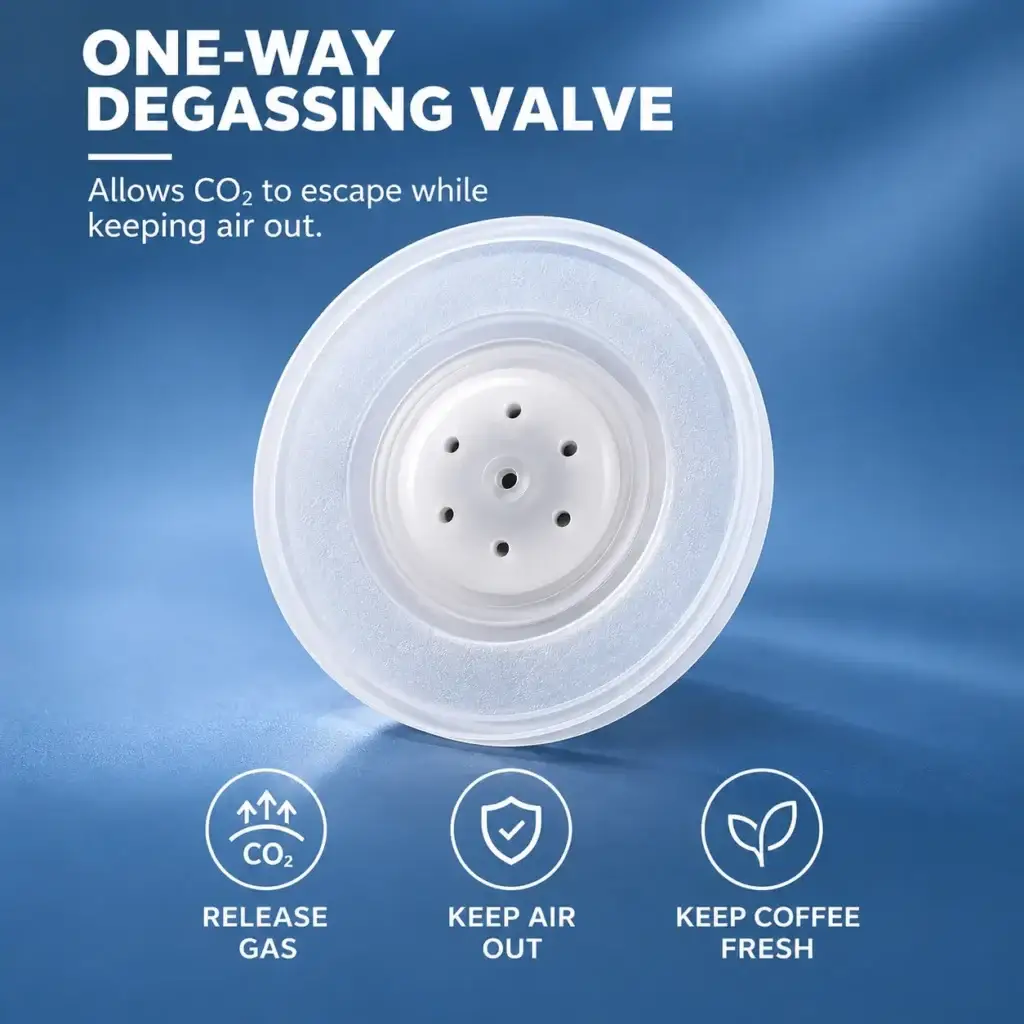
A degassing valve is a small assembly of three parts: a plastic body, a thin elastic membrane (usually silicone or synthetic rubber) and a cap. The principle is simple:
- When pressure inside the bag rises above the outside pressure, the membrane lifts and CO₂ vents out.
- When the pressure equalises — or outside air tries to push in — the membrane sits back down and seals the hole.
Air can leave; air cannot enter. That “one-way” behaviour is the whole point.
Which valve specifications matter to a coffee packaging buyer?
“One-way valve” describes a function, not a single universal component. Valve suppliers use different constructions and opening-pressure designs. Before comparing two quotations, request a technical specification for the exact valve proposed for your bag—not just a sample image or a generic description.
When evaluating a coffee bag degassing valve, ask which performance figures come from the component supplier and which tests will be run on your finished bag. A component data sheet does not automatically establish the seal performance of the valve after installation.
| Specification | Why it matters | What to request |
|---|---|---|
| Opening and closing pressure | Determines when the valve begins releasing gas and reseals as pressure falls. | Supplier data for the proposed valve model and its test method. |
| Venting capacity and gas flow | Helps assess whether the valve can manage the expected degassing behavior after the intended roast-to-pack interval. | Applicable flow or venting data and any test conditions. |
| Reverse leakage and seal integrity | A valve should not become an uncontrolled oxygen-entry path after venting. | Manufacturer test information and acceptance criteria for the finished pack. |
| Valve footprint, thickness and filter | Can affect pouch appearance, placement, contamination control and contact with coffee particles. | Component drawing, material information, any filter option and applicable food-contact documentation. |
| Attachment method | The valve-to-film bond is a potential leak path and must suit the chosen laminate and conversion process. | Application method, position tolerance and sample inspection procedure. |
Do not treat opening pressures, leak rates or valve constructions published by another manufacturer as UNIPACK’s guaranteed specification. For component-function terminology, see TricorBraun Flex’s valve FAQs.
Valve Placement: A Small Detail That Changes the Bag
The valve is normally mounted through a die-cut hole, heat-pressed into position, and sits slightly below the fill line so it does not submerge in beans. Placement affects three practical things: whether the filled bag stands and displays correctly, whether the valve can be seen (and clicked) by the customer on the shelf, and how the bag runs on your filling line. Decide valve position before approving the dieline, not after printing.
For artwork approval, ask for a flat dieline with the valve center marked and a filled, three-dimensional sample showing the final coffee volume. Check clearance from the top heat seal, zipper, fold lines and printed codes. The actual position must also be validated against the filled product level and equipment setup; a placement drawn on an empty bag may behave differently after filling.
The practical location of a coffee bag degassing valve should be checked on a filled and sealed sample—not selected from an artwork template alone. Confirm the proposed position against the actual coffee fill height, the planned seal zones and the equipment that will handle the bag.
Does Every Coffee Bag Need a Valve?
Not always — it depends on the coffee and the timeline:
- Whole bean, packed days after roasting: a valve is close to mandatory. This is the classic case the valve was invented for.
- Ground coffee: degasses faster, so pressure builds sooner — bags still commonly use valves, combined with slightly larger headspace.
- Coffee packed weeks after roasting: some roasters still use valves for shelf presentation and the “click” cue customers associate with quality.
- Instant coffee or pods: little residual CO₂, so valves are usually unnecessary.
Roast level and grind size change the degassing profile too, which is why the question to ask is not “should I use a valve?” but “when will I fill the bag after roasting?”
Valve decision guide: compare products and filling schedules
Use the following table as a discussion guide, not an automatic pass/fail rule. A coffee brand or co-packer should confirm the actual post-roast gas release, pack size, headspace, time to sealing, intended distribution conditions and filling method.
| Packaging situation | Valve consideration | Supplier or co-packer check |
|---|---|---|
| Whole beans packed soon after roasting | A one-way valve is commonly evaluated because CO₂ continues to evolve after sealing. | Roast-to-pack interval, headspace, filled-bag pressure and venting trial. |
| Ground coffee in sealed retail pouches | The need depends on the packing schedule and gas management process; do not choose solely by grind type. | Degassing behavior, filling conditions, sealing quality and pack pressure. |
| Roasted coffee packed after a longer resting period | A valve may still be selected, but the decision should be supported by handling and distribution tests. | Evidence from the actual coffee and expected storage period. |
| Instant coffee in single-use sachets | A degassing valve is generally not the main packaging requirement. | Moisture barrier, seal integrity, dose control and powder-flow compatibility. |

What the Valve Does Not Do
A common misconception: the valve keeps coffee fresh. It does not. The valve only vents CO₂ — it does not stop oxygen, moisture or aroma moving through the film. Freshness is the job of the barrier layer (aluminium foil or high-barrier laminates) plus a proper heat seal. A valve on a weak film is a vent, not a preservative.
Consider valve, laminate and closure as one packaging system
For a custom coffee bag, the film structure, valve and top seal perform different jobs. A high-barrier laminate may reduce oxygen and moisture transmission, but a faulty heat seal or poorly attached valve can still compromise the final pack. Similarly, a zipper improves the experience after first opening; it does not replace the original factory seal or eliminate the need to confirm post-roast gas handling.
UNIPACK’s flat-bottom coffee bag with valve product page lists PET/PE, PET/VMPET/PE and PET/AL/PE among customization options. These are construction examples rather than verified barrier values. Buyers should request the proposed full laminate, relevant barrier information, seal conditions and product-specific testing before selecting one structure. For another visual pouch format, see the existing eight-side seal coffee bag with valve.
For an example of how a valve manufacturer considers components alongside material and packaging equipment, see Fres-co’s degassing-valve system overview. Its supplier-specific claims and specifications should not be applied to an unrelated UNIPACK project.
For a coffee bag degassing valve to perform as intended, its attachment area needs to be compatible with the chosen film and converting method. The same pouch may require separate checks for valve function, seal integrity, barrier performance and resistance to handling damage; no single feature verifies all four.
What to Ask Your Supplier About the Valve
When specifying a custom coffee bag, put these points in your RFQ:
- Valve position on the dieline (and whether the artwork prints over or around it)
- Valve size and membrane material, suitable for food contact
- Whether the valve is applied during converting (strongest) or added afterwards
- How the valve behaves on your filling line, if you machine-fill
- A filled-bag squeeze test before mass production
Coffee valve packaging RFQ checklist
An RFQ is easier to evaluate when bidders receive the same project information. The following items distinguish product requirements from supplier-proposed specifications; the brand remains responsible for validating the finished pack against its coffee and market requirements.
| Provide with your request | Ask the supplier to confirm |
|---|---|
| Coffee format: whole bean, ground or instant; roast profile where relevant | Whether a valve is proposed and why, for this product and pack format |
| Roast-to-fill interval and sealing method | Valve model, installation method and available functional test data |
| Target fill weight, bag size and required headspace | Finished-pack dimensions, valve location and a clearly marked dieline |
| Manual packing or filling machine model; target filling conditions | Sample compatibility and validation responsibilities with the co-packer |
| Desired zipper, seal, finish, artwork and number of SKUs | Proposed laminate, seal configuration, print constraints and sample approval process |
| Destination country, transport conditions and shelf-life objective | Available material declarations, relevant tests and any limitations on proposed claims |
Rather than relying on an empty-bag squeeze test alone, request a representative filled-bag trial and agree in writing who evaluates seal integrity, valve function, pack inflation and transport handling. A squeeze check can be a useful quick inspection, but it is not a substitute for controlled testing or a shelf-life study.

7 Best Practices for Specifying a Coffee Bag Degassing Valve
Use these seven checks before approving artwork or placing a production order. They turn a general coffee bag degassing valve request into a comparable specification without assuming that one valve suits every roasted-coffee product.
- Confirm the roast-to-pack interval. State whether whole beans or ground coffee will be packed immediately or after a defined resting period; the CO₂ release profile affects the choice.
- Request the proposed valve model. Ask for available opening/closing behavior, venting data and material declarations rather than accepting a generic “one-way valve” label.
- Check the valve location on a filled sample. Verify clearance from seals, zipper tracks, printed information and the intended filled coffee level.
- Review the whole laminate structure. Distinguish gas release through the valve from oxygen and moisture resistance of the actual packaging film and seals.
- Match the application to the filling line. Share the machine type, sealing setup, handling points and proposed valve orientation with the supplier and co-packer.
- Agree on sample acceptance criteria. Define what will be checked on the representative finished bag, including appearance, attachment and suitability for the intended packing process.
- Keep evidence with the approved specification. Record the valve model, dieline, film construction, sample approval and any relevant tests so repeat orders can be compared consistently.
The right coffee bag degassing valve specification is the one that has been assessed for the buyer’s actual product and packaging conditions. An empty-bag demonstration alone cannot establish every performance requirement.
How UNIPACK Adds Valves to Custom Coffee Bags
We produce coffee packaging from film extrusion through printing to bag conversion, so the valve is specified as part of the structure from day one — not retro-fitted. We mount the valve during converting, match its position to your dieline and filling method, and run filled-bag tests before the production run is approved. Whether your project is a flat-bottom pouch for retail shelves or a stand-up pouch for subscription boxes, the valve works as part of the design.
To review the options available on a real product page, compare our custom flat-bottom coffee bags with one-way valve with the broader coffee packaging solutions overview. Product photographs illustrate packaging formats; the exact film structure, valve model, final artwork and production arrangements should be agreed for the buyer’s order.
When requesting a quotation for a coffee bag degassing valve configuration, include your pack size, roasted-coffee format, filling process and intended selling market. Ask the supplier to identify which details are confirmed specifications and which require a physical sample or further testing.

FAQ: Coffee Bag Degassing Valves
Are degassing valves recyclable?
No — the valve is a separate plastic part. Kraft-look bags with valves are composite structures; “recyclable” claims need to be checked case by case.
Does the valve affect shelf life?
Indirectly: it lets you pack earlier (less rest time, more aroma retained), but the barrier film — not the valve — protects against oxygen.
Can I add a valve to bags that are already printed?
Valves are heat-mounted during bag conversion. For existing bags it is impractical; specify the valve before production.
How should I evaluate valve placement before approving a coffee bag?
Ask for a marked dieline and a representative filled sample. Confirm that the location suits the proposed fill volume, clearances around seals and zippers, artwork, and the equipment used to fill and close the pouch. Agree the acceptance criteria with the supplier and co-packer.
Does adding a valve make a coffee bag recyclable?
Not by itself. The claim depends on the materials in the complete bag, the specific valve construction and the collection and recycling pathway in the destination market. Some valve manufacturers offer alternative material designs; request documentation for the exact system rather than transferring another supplier’s claim to your finished pack.
Need coffee bags for your brand? Get a quote →
We’ll be at WEPACK 2027 (Booth E3D445, Shanghai, April 27–29). DM us “WEPACK” for free entry registration + a free sample pack.