-
Email queenie@hellounipack.com
-
WhatsApp +8619807883476

Flat Bottom vs Stand Up Coffee Bags: A Practical Buyer’s Guide
When comparing flat bottom vs stand up coffee bags, the most expensive mistake is to select a shape from a mockup before checking what happens when it is filled, sealed and shipped. Both formats can protect roasted coffee when the film, closure and manufacturing process are correctly specified. But the two structures behave differently on a shelf, at a filling station and when a customer opens the bag.
For a specialty roaster or private-label coffee buyer, this is not just a design choice. A pouch that photographs beautifully may tip over when filled with your beans; a zipper may leave insufficient room for the final heat seal; or a one-way valve may conflict with the intended print area. This guide turns the comparison into a purchasing decision: which construction fits your product, how to evaluate barrier and valve options, what to test with your co-packer, and what to put in an RFQ.
If you are still exploring different coffee bag formats, barrier materials and degassing valve options, start with our guide to choosing custom coffee packaging before comparing these two pouch structures in detail.
Flat Bottom vs Stand Up Coffee Bags: The Practical Difference
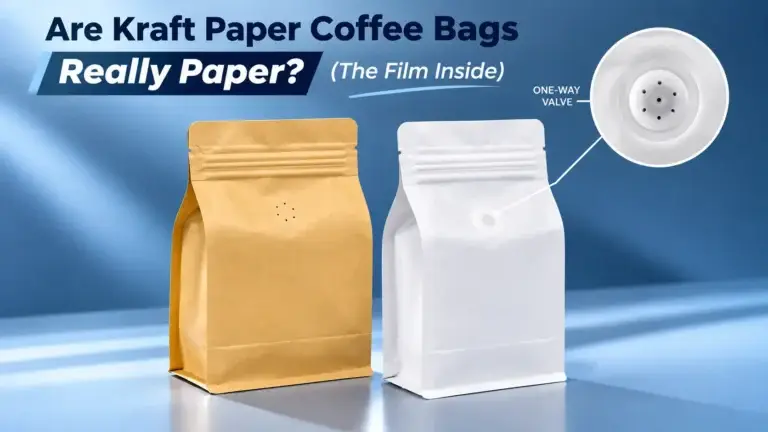
A flat-bottom coffee bag—also called a box-bottom or box pouch—typically has a defined rectangular base and distinct side panels. When opened and filled, it forms a relatively squared-off retail pack. A stand-up pouch (often called a doypack) generally relies on an expanding bottom gusset, with broad front and back faces and a less box-like profile. Both can stand on their own when properly sized and filled, but neither is automatically stable under every fill condition.
Do not use the phrase “self-standing” as a technical drawing. It describes a function, not a unique gusset construction. Ask for a dieline, bottom view and filled sample. This matters when a supplier’s marketing photograph resembles a box pouch but a quotation says “stand-up pouch.” The final agreed construction should be unambiguous in the purchase specification.
| Purchasing criterion | Flat-bottom coffee bag | Stand-up coffee pouch |
|---|---|---|
| Bottom geometry | Defined rectangular or box-style base, often with side panels | Expandable bottom gusset; commonly a curved or pouch-shaped filled profile |
| Shelf appearance | Structured, squared-off presentation; useful for aligned retail ranges | Flexible silhouette; can suit retail, subscription and sampling lines |
| Artwork area | Front, back and defined sides can carry separate design elements | Front and back usually dominate; side branding area depends on the design |
| Filling consideration | Bag opening, side folds, supported base and handling equipment must be checked | Pouch opening, bottom-gusset expansion and pick-up/sealing must be checked |
| Valve and zipper | Options can be available; placement must be approved on the dieline | Options can be available; placement must be approved on the dieline |
| Cost tendency | Can involve more converting complexity, depending on construction and quantity | Often simpler, but actual pricing depends on film, print, size and run |
| How to approve | Filled stability, dimensions, top seal, valve clearance and transit checks | Filled stability, opening, top seal, gusset deployment and transit checks |
The table describes format characteristics, not universal performance rankings. A badly proportioned flat-bottom bag can be less stable than a well-designed doypack. A foil laminate on either format may outperform a poorly specified film on the other. Your product, film and finished-pack tests determine the result.
Which Shape Fits Your Selling Channel?
Premium retail: give the shelf dimensions a job
Flat-bottom bags are attractive when a coffee range needs a defined front face, a consistent edge-to-edge presentation and separate side areas for origin details, brew guidance or multilingual information. Yet extra panels only help if the brand actually has useful content for them. Compare the filled width, depth and height against the shelf allocation. Check how the bag looks beside neighboring products, not just as an isolated 3D render.
Visual presentation is an important part of planning a retail coffee range, but it is only the starting point. As you explore packaging ideas and develop your brand’s visual direction, you can stay connected with UNIPACK through our official Instagram and Facebook pages, as well as our YouTube and TikTok channels. Any visual references should then be evaluated against actual filled samples, approved dielines and the requirements of your coffee packaging project.
UNIPACK lists custom flat bottom coffee bags with printed panels, laminated-material options, and zipper/valve choices. This is a relevant product example, but final dimensions, film and closure details need to be confirmed for the buyer’s SKU.

Subscription and direct-to-consumer: prioritize repeatable packing
For e-commerce, the bag may spend more time in a mailer than on a retail shelf. A stand-up pouch can be a suitable candidate where the brand prioritizes flexible stock storage and a familiar resealable format. But freight savings cannot be inferred from pouch shape alone: a rigid mailer, protective void fill, dimensional-weight bracket and order mix may matter more than the empty pouch.
The UNIPACK self-standing coffee pouch listing documents resealable closures, custom printing and optional one-way degassing valves. Its product name alone does not prove whether a requested order will use a classic doypack bottom or a different self-supporting construction. Ask for a physical sample with the exact proposed gusset.

Multiple roast profiles: control the number of pouch variations
A brand selling several origins can often simplify purchasing by standardizing a bag structure, film and closure while changing the artwork or labels. However, not all coffees occupy the same volume at the same weight. Bean size, roast degree, bulk density, grind distribution and product handling influence fill height. If one standard size is planned for several SKUs, test the least-dense and most-dense products before freezing the dieline. A bag sized for ground coffee may not provide a suitable headspace for an equal mass of whole beans.
Do Whole Bean and Ground Coffee Need Different Bags?
Neither flat-bottom nor stand-up construction is exclusively for whole beans or ground coffee. More important variables are the usable internal volume, product flow, seal contamination risk and targeted aroma protection. Whole beans may settle and distribute differently from ground coffee. Fine grounds can migrate toward a heat-seal area, particularly when fill height, dust control or dosing are poorly matched.
When comparing samples, fill each candidate to the target net weight, not a nominal “250 g” label printed on a supplier sample. Photograph the filled shape, measure headspace and check whether the top can be sealed without product in the sealing zone. Repeat for the lightest, bulkiest or oiliest coffee the line expects to handle. The approved nominal weight and finished dimensions should be written on the order specification rather than inferred from generic capacity charts.
| Product/use case | Start with this question | Potential concern to trial |
|---|---|---|
| Freshly roasted whole beans | How soon after roasting is the bag sealed, and is a degassing valve needed? | Gas release, bag expansion, fill volume and valve performance |
| Ground retail coffee | What grind range and dust level will reach the sealing jaws? | Seal contamination, aroma exposure, dosing repeatability |
| Multi-origin subscription program | Can one bag size accommodate the bulkiest coffee in the range? | Headspace, stock complexity, label legibility and mailer fit |
| Gift or premium shelf line | What are the actual shelf, carton and display dimensions? | Stability, scuffing, printed panel visibility and transit damage |
Degassing Valves: Specify the Packing Process First
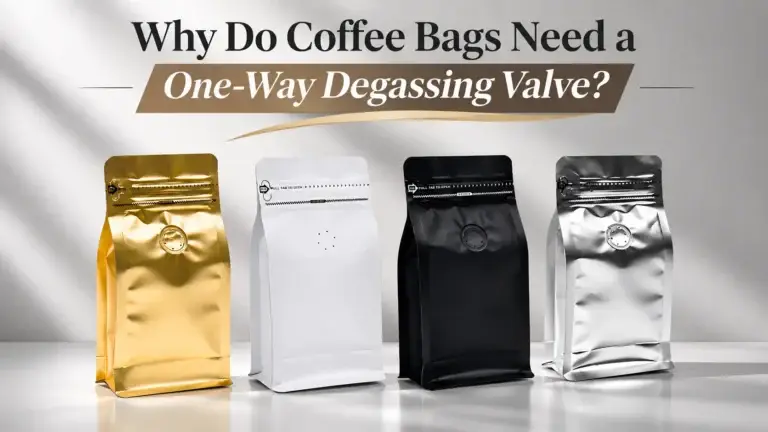
Roasted coffee continues to release carbon dioxide after roasting. For certain freshly packed coffees, a correctly specified one-way degassing valve provides a route for gas to escape while limiting air entry through that component. Whether a valve is needed depends on the product, resting and packing schedule, distribution process and required package performance—not on whether the bag has a square or curved base.
Buyers sometimes assume that a valve eliminates the need for barrier film. It does not. A valve is one interface in a complete package; film and seals still determine much of the pack’s protection. The valve also has a position, attachment zone and opening characteristics that must work with the chosen laminate, filling process and print layout.
The UNIPACK flat-bottom coffee bags with valve page shows that valve integration is part of its listed product options. A procurement brief should still request the proposed valve specification and location, rather than assuming that any valve can be installed anywhere on the bag.

Valve checks before approving a printed bag
- Confirm whether the coffee is packed immediately after roasting, after resting, or after grinding.
- Request a valve-position drawing that clears the zipper, final heat-seal zone, required markings and critical artwork.
- Agree who verifies valve attachment and functional performance on representative filled packs.
- Evaluate internal gas management, transit pressure changes and storage conditions using the brand’s defined acceptance plan.
- Do not claim a fixed shelf life based on the presence of a valve alone.
For a more detailed explanation of valve operation, placement and supplier specifications, see our guide to one-way degassing valves for coffee bags.
For a background explanation of why valves are used on roasted-coffee packaging, see Roastar’s packaging FAQ. Supplier guidance is useful for understanding the mechanism but does not replace product-specific validation.
Barrier Films: Compare the Finished Structure, Not Just Its Name
UNIPACK’s relevant coffee product listings mention film structures including PET/PE, PET/VMPET/PE and PET/AL/PE. These are meaningful starting points for discussing printability, heat sealing and possible barrier characteristics. They are not interchangeable declarations of oxygen transmission, water-vapor transmission or storage life. Thicknesses, coating quality, lamination, folds, seal integrity and actual exposure conditions all matter.
Use the following questions rather than asking the supplier to choose the “best barrier bag” without a specification:
| Specification point | Buyer should provide | Supplier should clarify |
|---|---|---|
| Product sensitivity | Whole bean/ground, roast schedule, aroma and light sensitivity | Proposed complete film stack and why it fits the use case |
| Storage and channel | Target markets, distribution duration, temperature and humidity envelope | Available film and finished-pack test evidence under relevant conditions |
| Heat sealing | Sealer type, jaw profile, line settings and contamination risks | Sealant layer, recommended process window, required trials |
| Food contact | Destination-market requirements and intended food-contact use | Available documentation relevant to the actual material and application |
| Recycling claims | Target market and approved sustainability claim language | Component-level construction, evidence and disposal limitations |
Never infer that “recyclable” means curbside recyclable in every country, or that a kraft-paper surface makes a multilayer pouch plastic-free. Films, adhesives, valves and zippers all affect the final packaging assessment. For EU-bound products, the European Commission’s food-contact materials guidance explains the general framework. The European Commission’s 2026 packaging regulation update describes the start of application of the EU Packaging and Packaging Waste Regulation; market-specific obligations and transition provisions still require legal review.
Filling-Line Compatibility: The Question a Mockup Cannot Answer
A coffee bag supplier and a filling-machine supplier can each supply a technically sound component that performs poorly when combined. To reduce this risk, ask the roastery or co-packer to confirm whether it fills premade pouches or forms bags from rollstock. Do not assume a particular machine can run both formats just because they are both flexible packaging.
Premade pouch lines
For premade flat-bottom and stand-up pouches, investigate how the machine presents the bag, grips and opens the mouth, positions the fill nozzle and holds the pouch during dosing. Check whether side gussets or a box base interfere with the fixtures. Confirm that the zipper and valve clear the grippers, jaws and inspection equipment. The filled shape may also affect downstream case packing or labeling.
Manual and semi-automatic packing
Smaller roasteries may fill from a hopper or weighing station before sealing the top with a separate sealer. Here the practical questions are opening access, bag support, the ability to keep coffee away from the seal area and consistent seal positioning. A larger mouth can help an operator, but its benefit must be tested with actual product and workflow.
Rollstock form-fill-seal lines
If the existing machine makes bags from a roll of printed film, changing to a premade flat-bottom pouch may require a different feeding or sealing arrangement—not just a new printed film. Before requesting a price, confirm the line architecture with the machinery team. A packaging printer should not promise machine compatibility without a suitable engineering trial.
For a useful independent machinery perspective, see the packaging engineering discussion in HENGPACK’s coffee bag machine format comparison. Its machine-specific examples should be checked against the buyer’s actual equipment rather than copied as universal requirements.
The Four Tests That Should Decide Between the Two
1. Filled stability and shelf presentation
Prepare representative samples at the approved net weight. Place them on the actual shelf or a dimensional equivalent and document tipping, lean, face visibility and how consistently the bottom opens. Do the test after normal handling, not only immediately after carefully hand-forming a sample.
2. Filling and final-seal quality
Run a controlled trial on the intended line. Record unsuccessful pouch openings, product caught in the seal, resealability after first opening and rejected finished packs. Agree the acceptance limits in advance with the quality team; avoid converting a supplier’s empty-machine cycle rate into an assumed production output.
3. Filled-pack barrier, leak and handling evaluation
Assess the complete package under the intended storage and logistics conditions. Consider appropriate seal-strength, leak-integrity, gas-exchange or storage testing based on the product and brand quality plan. A dry, unfilled sample can reveal mechanical fit but cannot demonstrate a coffee shelf life. Record the test method and acceptance criteria before comparing suppliers.
4. Packed distribution trial
Pack the pouches in the real shipping case or consumer mailer. Evaluate scuffing, seam damage, valve interference, case loading, stacking and the customer experience on receipt. For retail, check the actual display-ready case if one will be used. For subscriptions, include the bag and mailer together in the review.
| Trial | What to record | Who should sign off |
|---|---|---|
| Filled sample | Net weight, external dimensions, headspace, shelf stability | Brand/product development |
| Packaging-line run | Pouch opening success, filled output, seal quality, reject causes | Roaster or co-packer and QA |
| Protection checks | Applicable test methods, results and deviations from acceptance limits | Product quality/compliance |
| Transit and shelf review | Case fit, damage, scuffing, retail and delivery experience | Operations, marketing and logistics |
Three Buying Scenarios—and Why the Answer Changes
Scenario A: A specialty roaster launching a premium retail range
Illustrative procurement example, not a customer case study. The brand values a squared-off front face, multiple side-panel messages and a repeatable shelf presentation. A flat-bottom sample is a sensible first candidate. But the production team needs to confirm filled dimensions, valve and zipper clearance, and whether the selected bag is easy to handle on its packing station. If the boxed shape causes seal misalignment on the existing line, the aesthetic advantage may not justify the conversion work.
Scenario B: A private-label brand shipping several small-batch coffees
Illustrative procurement example. The business changes artwork frequently and wants to keep unused stock low. A stand-up pouch might simplify the initial range, but printing setup, ordered quantity per design, closure specification and mailer dimensions will drive the true commercial comparison. Test one standard structure against the largest-volume roast before placing a multi-design order.
Scenario C: A co-packer serving both beans and finely ground coffee
Illustrative procurement example. The co-packer already operates a pouch-filling line. The priority is a repeatable opening and final seal across products, with appropriate aroma protection. The best bag is the one that passes an agreed line trial with both coffee types and meets the filled-pack quality plan. It might be flat-bottom, stand-up or two separate SKUs. Appearance alone does not settle the choice.
Do Flat-Bottom Coffee Bags Cost More?
Some flat-bottom constructions involve additional converting steps or material usage, but it would be misleading to promise that stand-up pouches are always cheaper. The relevant comparison is a complete quotation for the same net fill, comparable protection requirement, print coverage, closure and delivered quality. A thicker film, extra color, foil effect, special zipper or low-volume print run can change the result more than shape alone.
When comparing supplier offers, separate unit pouch price from artwork setup, printing method, plates (if applicable), tooling, proofs, samples, freight, duties, minimum order per design and any permitted production quantity tolerance. Then add the roastery’s estimated filling loss, line changeover effort and shipping cube. The lowest quoted empty-bag unit price is not necessarily the lowest total cost of an acceptable finished pack.
UNIPACK product pages may display general MOQ or lead-time statements, but this article does not treat those as verified terms for a new custom specification. Obtain a written quotation for the exact agreed construction and artwork quantities.
Coffee Bag RFQ Checklist: What to Send Before Asking for Price
An RFQ should make the two structures directly comparable. Copy the following fields into your sourcing sheet and ask each supplier to identify any assumptions rather than silently substitute a material or closure.
- Coffee: whole bean or ground; roast profile; age at packing; target net weight; product bulk-density or fill-trial sample availability.
- Channel: retail shelf, subscription shipment, wholesale or mixed; destination markets; expected logistics and storage conditions.
- Bag construction: flat-bottom/box pouch or true bottom-gusset doypack; technical dieline; filled and unfilled W × H × D dimensions; target tolerance.
- Film: requested or proposed complete laminate; food-contact layer; finishing; protection targets and evidence requirements.
- Closure: heat-seal zone, resealable zipper if needed, tear feature, one-way valve type and proposed placement.
- Printing: separate artwork files or SKU count; colors; Pantone targets when relevant; matte/gloss effect; printproof method; barcode/lot-code area.
- Line interface: premade pouch versus rollstock; machine make/model if available; gripper and jaw clearance; filling temperature; representative sample trial.
- Quality plan: fill/stability trial, seal integrity, valve functionality if applicable, shipping check, documentation and approval responsibility.
- Commercial terms: quantity per design, order tolerance, sample/proof charges, tooling charges, confirmed production lead time, Incoterms and delivery destination.
- Compliance: target market, relevant food-contact declarations and authorized environmental claims for the actual material.
If the packaging supplier does not fill coffee, name the co-packer or production contact who will approve the filling trial. This avoids treating an empty pouch sample as final production approval.
Frequently Asked Questions
Are flat-bottom coffee bags the same as stand-up pouches?
No. Both may stand upright, but a box-bottom construction and a typical bottom-gusset doypack differ in geometry. “Self-standing” is not precise enough for a purchase order. Confirm the actual gusset and base by technical drawing and filled sample.
Which is better for 250 g or 1 lb of coffee?
Either format can be considered, but neither weight automatically maps to one reliable set of dimensions. Whole beans and grounds can occupy different volumes. Specify the weight and representative coffee, then test-fill the proposed bag before approving size and headspace.
Do both formats support one-way degassing valves?
Depending on the supplier’s design and materials, both can have valve options. Valve position, the attachment method and compatibility with the rest of the bag must be confirmed for the specified construction.
Is a kraft-look coffee bag automatically recyclable?
No. Exterior appearance does not disclose all layers, adhesives or accessories. Review the complete packaging construction and the recycling or disposal rules in the destination market before making a claim.
Does a zipper replace the factory heat seal?
Do not assume so. In many retail coffee bags, the zipper is intended for consumer reclosure after the initial package is opened, while the production seal provides first-sale integrity. The actual design and process must be validated for your product.
Can I switch from a stand-up pouch to a flat-bottom bag without changing my filling machine?
Sometimes, but compatibility cannot be inferred from the packaging material alone. Check pouch feeding and opening, gripper positions, top seal, valve and zipper clearance, and downstream handling. Request a line trial with representative filled samples.
What should I approve before mass production?
Approve the exact dieline, material construction, print proof, closure and valve placement, filled dimensions, food-contact documentation, trial results, agreed quality limits and the project-specific quotation. Assign sign-off responsibility to both the brand and the filling partner.
Choose the Bag That Works After Filling
The best coffee bag is not necessarily the most rigid, lightest or visually impressive. It is the format that protects the specified coffee, works consistently on the intended line, meets the retail or delivery requirement, and can be purchased under a clearly defined specification.
Explore UNIPACK’s custom coffee packaging solutions, compare its flat-bottom coffee bags and self-standing coffee pouches, and review the flat-bottom valve bag options where degassing is part of the process. To request a project-specific assessment, contact UNIPACK with your coffee type, target fill, bag drawing or sample, filling method and artwork quantities. Material suitability, valve details, MOQ, documentation and lead time should then be confirmed for the actual order.