-
Email queenie@hellounipack.com
-
WhatsApp +8619807883476

Primary vs Secondary Cosmetic Packaging: A Skincare Brand’s Buying Guide
For skincare brands, primary vs secondary cosmetic packaging is a question of what each layer must protect. Primary packaging is the container or sealed pouch that directly holds a skincare formula. Secondary packaging surrounds, presents, or groups that primary pack—for example, a printed carton around a sheet-mask sachet or a magnetic box holding a skincare set. Choosing one before specifying the other is a common reason packaging projects need expensive revisions.
For procurement teams, the useful question is not simply “pouch or box?” It is: What contacts the formula, what protects the retail unit, what works on the filling line, and what must be tested before the purchase order? This guide uses skincare samples, sheet masks, refills, cartons and gift sets to turn those questions into a sourcing specification.
Primary vs Secondary Cosmetic Packaging: What Changes in the Specification?
Packaging levels describe a component’s role, not its material, price or appearance. A pouch holding cream directly is primary packaging; a folding carton carrying sealed pouches is secondary packaging. A corrugated case used to ship completed retail units is normally transport or tertiary packaging. The classification may vary by how the product is packed and sold, so describe the actual packing system in your brief.
| Decision | Primary cosmetic packaging | Secondary cosmetic packaging |
|---|---|---|
| Main job | Contain formula; control leakage, exposure and dispensing | Protect or group primary packs; support labeling and presentation |
| Typical skincare examples | Sample sachet, sheet-mask pouch, refill spout pouch, bottle or jar | Printed folding carton, sleeve, rigid gift box and fitted insert |
| Critical interfaces | Formula, contact layer, seal, closure, filling equipment | Container dimensions, insert fit, assembly, retail and transit handling |
| Evidence to request | Filled-pack compatibility and stability plan, seal/leak checks, filling trial | Structural sample, print proof, packed-product fit and transit checks |
| What it cannot replace | A primary seal cannot replace protective shipping design | A beautiful carton cannot compensate for an incompatible or leaking primary pouch |
Procurement rule: approve the product-contact system before finalizing the external box dimensions. A change to the pouch fill profile, bottle closure or sachet count may also change the carton, insert and shipper.
Start With the Formula and the Packing Route
1. Identify what will touch the product
A serum, oil-rich balm, water-based lotion and sheet-mask essence do not present identical packaging risks. Ingredient families, fragrance components, pH, alcohol content, viscosity, intended shelf life and storage conditions can affect how the formula interacts with a contact film, adhesive system, cap or seal. A supplier’s material list is a starting point—not proof that a particular cosmetic formula is compatible.
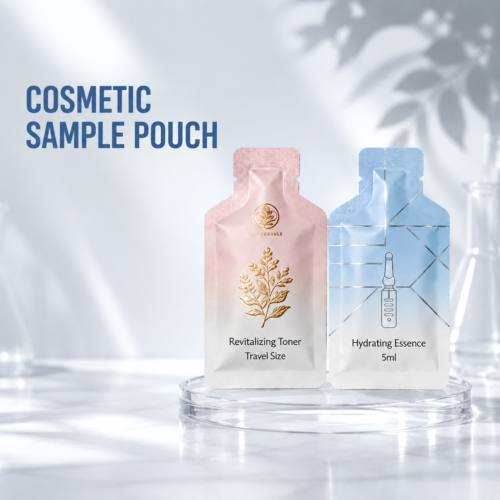
For example, UNIPACK’s custom cosmetic sample pouch page lists PET/PE and PET/VMPET/PE laminated options. Its face mask packaging bags page also lists PET/AL/PE. These are site-listed candidate structures, not universal recommendations for every serum or cream. Ask which structure is proposed for your actual formula and have the responsible formulation/filling team validate the filled pack.
2. Specify barrier performance as a requirement, not a marketing adjective
Oxygen, moisture and light are different exposure mechanisms. Metallized films and aluminum-foil laminates may be considered when a project needs stronger light or gas-barrier characteristics, while simpler laminates may suit other requirements. Yet actual performance depends on the complete structure, thickness, converting process, seals, flexing, storage and test conditions. Do not assume an “aluminum-look” print finish provides a foil barrier, or that every foil laminate has the same measured oxygen or water-vapor transmission rate.
Instead of asking for “high-barrier skincare packaging,” provide the formula’s sensitivity, target storage conditions and shelf-life objectives. Request relevant test methods, target acceptance limits and evidence for the finished pack, with quantitative requirements set by the brand’s technical team. Where the client has not supplied limits, record them as to be determined after formulation and stability review.
3. Decide who forms, fills and seals the pack
There is a meaningful distinction between purchasing premade empty pouches and purchasing printed rollstock for a form-fill-seal line. A co-packer may accept one format and reject the other. Before requesting a dieline, obtain the filling partner’s equipment information: web width and winding direction if rollstock is used; supported pouch opening and final-seal geometry if premade packs are used; fill temperature, product viscosity, jaw geometry, sealing temperature window, dwell time and coding position as relevant.
For small sachets, a tear notch can improve opening but can also interact with edge seals and artwork. Leave the required seal area clear. Confirm whether the sample is a single dose, whether the user can empty it cleanly, and whether the seal survives handling. A visually convincing dry mockup is not equivalent to a filled-line trial.
Select Primary Packaging by Use Case
Sample sachets: prioritize dose, opening and clear artwork
Single-use samples can support sampling campaigns, subscriptions and travel kits. A flat sachet occupies little distribution space, but the usable dose depends on internal cavity dimensions, seal margins and product viscosity—not external dimensions alone. Miniature artwork also creates unusually tight constraints for instructions, lot codes and required market information.
The published UNIPACK sample pouch listing demonstrates custom printed small pouch formats and laminated-film choices. It does not establish that every sample program, filling machine or formulation is supported without review. Brands should send the filled sample target, expected viscosity, intended opening method and label content before approving print artwork.
Sheet-mask pouches: evaluate the complete wet pack
A sheet-mask pouch holds a folded substrate plus essence, so fill distribution, pouch dimensions, wet-pack weight and sealing-zone contamination require attention. Ask the co-packer to test whether the wet mask fits consistently, whether the filled pack lies acceptably for carton packing, and whether handling creates leaks near the seals or tear features.

Refill spout pouches: assess the fitment as part of the package
For compatible skincare and personal-care refills, a spout pouch may be convenient for dispensing into a reusable container. Its closure and fitment add interfaces that are absent from a flat sachet. Verify cap torque or closure function where applicable, leak performance after handling, product flow at the selected spout, filling access, and the ability to empty the refill without excessive waste.
UNIPACK lists custom cosmetic spout pouch packaging with laminated structures and configurable printing. The correct spout, sealant and fill-line route must still be confirmed against the formula; a product listing is not a universal fill-compatibility approval.
When Do Skincare Products Need Secondary Packaging?
A secondary component earns its place when it does at least one useful job: protecting the primary container, organizing a set, providing an appropriate area for required information, improving shelf handling or creating a specific unboxing experience. Adding a box to every SKU can increase components, assembly work, freight cube and disposal burden without necessarily improving product protection.
Folding cartons: practical for unit packs and multi-sachet sets
A printed folding carton can work around sheet-mask sachets, bottles or other retail units. Paperboard grade, caliper, fold geometry and closure choice influence stiffness, stacking and assembly. A carton shipped flat generally uses less warehouse space than an assembled rigid box, but its protection depends on product weight, fit and how the completed sales unit is shipped.
UNIPACK’s facial mask packaging box page lists customizable paperboard structures, printing and finishes for mask-related retail packaging. A box around sealed mask pouches should be specified as a secondary presentation and handling component—not as the barrier that contains the liquid essence.
Magnetic rigid boxes: appropriate for defined gift-set programs
Premium sets may justify a rigid box with a magnetic closure and fitted insert, especially where multiple primary containers need to remain organized. The trade-offs are higher material use, larger shipped volume, more assembly steps and potentially greater inventory risk when assortments change. A magnetic flap is a presentation closure; it does not make the cosmetic formula airtight or demonstrate tamper evidence.
UNIPACK’s magnetic skincare gift box page documents rigid paperboard, specialty paper, inserts and selected surface-finishing options. To commission a similar structure, provide physical samples of every bottle, dropper or sachet in the set—including closures and protective sleeves—and define the insertion and removal experience.

How to Compare Structures Without Comparing Unlike Jobs
| Format | Best purchasing question | Major limitation or risk | Typical verification |
|---|---|---|---|
| Cosmetic sample sachet | Will the selected film and final seals protect and dispense the intended dose? | Limited print space; possible filled-pack leakage or opening difficulty | Formula compatibility, filled-pack leak and opening trials |
| Sheet-mask pouch | Will the wet mask and essence fit the seal layout and filling process? | Wet-fill inconsistency, seal contamination, puncture or flex damage | Actual wet-fill trial, final seal inspection and handling trial |
| Cosmetic refill spout pouch | Will the fitment, cap and laminate work with the refill formula and dispenser? | Fitment leakage, difficult emptying, filling-line incompatibility | Fitment/closure checks, dispensing and filled-pack testing |
| Folding carton | Does the finished primary pack fit, remain protected and carry approved copy? | Crushed panels, poor fit, print or coding conflicts | Structural sample, artwork proof, packed-unit handling checks |
| Rigid magnetic gift box | Does the insert securely support the exact gift-set assortment? | Excessive volume, insert mismatch, assembly cost | Full set fit trial, assembly review and transit evaluation |
These are not five interchangeable ways to package the same formula. A trial sachet and a folding carton may be complementary components in one SKU. Compare solutions according to the role each is meant to perform.
Materials, Printing and Artwork: What Procurement Must Approve
Separate contact-material approval from print-finish approval
In a laminated pouch, the product-contact side, barrier layer, printing layer, adhesives and seal geometry each have different functions. Request a proposed structure with layer order and intended use. A matte or gloss exterior finish influences appearance; it is not evidence of chemical compatibility or measured barrier performance. Where oil-rich or solvent-containing formulations are involved, the formulator and the converter should agree on a risk-based compatibility plan.
Paperboard selection for a carton follows a different logic: grammage or caliper, stiffness, folding endurance, scuff resistance, print consistency and box-forming behavior. Finishes such as foil stamping, spot UV or soft-touch lamination may be available for specific UNIPACK paper products, but their feasibility and environmental claims need confirmation for the selected substrate and run.
Proof what matters, not just what looks attractive on a screen
Confirm the dieline revision, printed face, orientation, color references, ink and finishing intent, seal-free and glue-free zones, batch/lot-code area, barcode contrast and any market-specific copy. For a skincare range with multiple formulas or shades, maintain an artwork and revision matrix. Never assume two visually similar variants can share one printed run without reviewing the exact quantities and changeover requirements.
A digital visual is useful for composition. During the artwork development stage, brands can also connect with UNIPACK through our official Instagram and Facebook pages, as well as our YouTube and TikTok channels. These platforms are additional ways to stay connected with our brand, rather than substitutes for technical evaluation or physical samples.
A physical structural sample checks fit. A print proof checks reproduction. A filled production-style sample checks whether the complete system behaves as intended. Define which proof gates must pass before the buyer authorizes volume production.
Three Illustrative Skincare Buying Scenarios
The scenarios below are hypothetical procurement examples, not claims about UNIPACK customer projects or test results.
Scenario A: A private-label brand launching a single-use serum sample
The marketing brief asks for an elegant small sachet for sampling. The technical brief asks for a measured fill, a laminate compatible with the serum, a tear position customers can use, readable required copy and a filling route accepted by the co-packer. A secondary carton may be unnecessary for an individually handed-out sample; for a coordinated multi-sachet kit, an outer sleeve or carton can improve organization. The purchasing decision should follow the distribution method rather than adding a box by default.
Scenario B: A sheet-mask brand moving into multipack retail
The brand already fills individual wet-mask pouches and wants a multi-unit retail carton. The primary pouch dimensions and filled thickness must be measured first. Procurement can then specify a folding carton around the actual stack, leaving the primary seal and formula unchanged if those are already validated. Check whether the final cartons stack well, whether masks shift in transit, and whether the artwork and ingredient information meet target-market requirements.
Scenario C: A premium holiday skincare gift set
The launch includes a serum bottle, cream jar and sample sachet. The brand wants a magnetic box. Before choosing foil and soft-touch finishes, the buyer provides each filled container’s maximum dimensions, weights and closure details, plus its desired unboxing sequence. A fitted insert is prototyped and tested with physical product samples. A protective shipping solution is still needed; the gift box alone should not be assumed to withstand courier handling.
A Procurement RFQ Checklist for Cosmetic Packaging
An effective RFQ separates what the buyer already knows from what the supplier needs to propose. Send the same brief to all suppliers so quotations compare the same materials, proofs and acceptance criteria.
| RFQ field | Information to send or request |
|---|---|
| Product and market | Cosmetic type, formula revision, intended countries, distribution channel and responsible regulatory reviewer |
| Primary use and fill | Target dose and units, viscosity/handling notes, storage conditions, filling partner and equipment route |
| Pack format | Premade sachet, rollstock, sheet-mask pouch, spout refill, carton or gift set; specify layers separately |
| Materials | Proposed film layer order or paperboard grade, dimensions, thickness/caliper and approved alternatives |
| Closures and seals | Seal locations and minimum clearances, tear features, spout/cap if applicable, coding and seal acceptance criteria |
| Print and artwork | SKU/version matrix, dielines, CMYK/Pantone references, required languages, finish and proof standard |
| Secondary fit | Physical product samples, total set weight, insert drawing, orientation, flat/assembled delivery and pack count |
| Testing and ownership | Who performs filled-pack compatibility/stability, leakage, print, assembly and transit tests; who signs off |
| Commercial quote | Quantity per SKU/artwork, proposed MOQ for this project, tooling/plates, sample costs and changeover assumptions |
| Planning and logistics | Approval milestones, project-specific lead-time proposal, packing method, shipping destination and Incoterms |
| Change control | Revision number, approval samples, allowable tolerances, deviations and reapproval triggers |
Do not combine different minimums: the minimum number of empty printed packs, the minimum run accepted by a filling partner and the number of finished samples required by marketing are not necessarily the same. Ask each supplier to identify the unit of measure and the quantity per artwork.
What Should Be Tested Before Approval?
| Approval gate | Question | Typical responsible party* |
|---|---|---|
| Formula/contact assessment | Is the filled formulation compatible with every product-contact component over the intended conditions? | Brand/formulator, with packaging and filling partners |
| Sealing and leakage | Does the actual process make repeatable, intact seals on representative filled packs? | Filler/co-packer with packaging supplier |
| Use and dispensing | Can consumers open, dispense or refill without unacceptable mess or residual product? | Brand/product team |
| Artwork and labeling | Is the final market-specific copy complete, legible and assigned to the right SKU? | Brand’s responsible regulatory reviewer |
| Carton and insert fit | Does the finished, filled pack fit without damaging closures, seals or decorations? | Packaging supplier and brand |
| Distribution | Does the packed sales unit survive the agreed shipping and handling profile? | Brand/logistics team with relevant supplier |
*These are suggested ownership assignments for a buying plan; the actual scope must be agreed contractually. No specific test result or certification is implied for UNIPACK.
Regulatory and Sustainability Checks for International Buyers
Packaging and cosmetic product labeling are related but separate compliance questions. A converter may print artwork accurately while the brand’s regulatory team remains responsible for confirming the content, language, placement and claims required in each sales market.
For the United States, the U.S. FDA’s summary of cosmetics labeling requirements explains how cosmetic labeling obligations apply to immediate and outer packaging, including ingredient declarations, identity, net quantity and certain warnings. Some skincare products may also be regulated as drugs depending on their intended uses and claims; do not approve their labels as ordinary cosmetics without professional review.
For EU-bound packaging, review the applicable cosmetic rules alongside the European Commission’s packaging waste framework. Regulation (EU) 2025/40 generally applies from 12 August 2026, but individual requirements and transition dates differ. A claim such as “recyclable,” “plastic-free,” or “FSC-certified” requires evidence for the exact component, sourcing chain and destination market; an attractive paper appearance is not adequate substantiation.
For either market, request available declarations or test records specific to the selected structure rather than assuming that a supplier-wide badge automatically qualifies every product and every finished pack.
Frequently Asked Questions
Is a cosmetic sample sachet primary packaging?
Yes, when the sachet directly contains the cream, serum, gel or other product. The printed sleeve or carton that holds sealed samples serves another packaging role. Confirm the intended sales configuration before assigning technical or labeling requirements.
Can a paper carton replace a barrier pouch for a wet sheet mask?
Not in a typical sealed wet-mask system. The inner pouch contains the mask and essence and must meet the relevant containment requirements. The external carton can group, protect and present sealed pouches, but it should not be treated as the moisture barrier without a separately engineered and validated design.
Is PET/AL/PE always better than PET/PE for skincare?
No. The desired barrier, contact compatibility, light protection, production method, disposal goals and cost all matter. Compare proposed constructions against defined requirements and test the filled package. A listed film option does not establish universal suitability.
Do all skincare bottles need a folding carton?
No. A carton should provide a clear protection, labeling, merchandising or packing function. If the product can be sold safely, labeled correctly and distributed effectively without an individual carton, an additional component may be unnecessary.
Can a magnetic skincare gift box act as a shipping box?
Do not assume so. Its main role is usually product organization and presentation. The assembled retail set may still need a correctly specified protective outer shipper and distribution testing to address transport risks.
What information should I send to a packaging supplier first?
Send the formula/application, actual product dimensions, preferred format, quantity per artwork, filling method, target market and approximate launch window. Ask for suitable material and structure proposals, a proof plan and a project-specific quotation rather than expecting a universal MOQ or lead time.
Choose the Packaging System, Then Request the Quote
Primary packaging protects the product itself. Secondary packaging supports the primary pack’s journey through the brand, filling, retail and gifting experience. For skincare brands, a defensible packaging decision connects the formula, the manufacturing process, the physical unit, the artwork and the distribution plan before it commits to production.
Explore UNIPACK’s cosmetic packaging solutions and beauty and personal care paper packaging. If you already have a draft specification, contact UNIPACK with the pack role, product details, artwork quantities and testing needs. The team can discuss relevant structure and printing options, while formula validation, compliance evidence, MOQ and production timelines are confirmed for the individual project.