-
Email queenie@hellounipack.com
-
WhatsApp +8619807883476

Pet Food Packaging: When to Choose Pouches, Folding Cartons or Both
Choosing the right packaging for pet food is not simply a choice between a plastic bag and a paper box. When comparing pet food packaging pouches vs cartons, buyers need to consider what touches the food, what protects it in storage, how it will be filled, and how it should appear in stores or online.
For many dry foods and treats, a properly specified flexible pouch can act as the protective primary pack. A folding carton can add branding, grouping and shelf presence. In some projects, the most practical answer is both: a sealed inner pouch or individual packs inside a printed outer carton.
This guide explains the differences, shows common applications and provides a specification checklist for pet food brands, contract packers and private-label buyers sourcing custom packaging.
Pet Food Packaging Pouches vs Cartons: Quick Comparison
Start with the job the packaging must perform. These are general starting points, not substitutes for testing your product and confirming local requirements.
| Format | Often a good fit for | What to verify |
|---|---|---|
| Flexible pouch or bag | Dry kibble, freeze-dried treats and other products needing a sealed primary pack | Film barrier, seal integrity, filling method, durability and closures |
| Folding paperboard carton | Retail display, boxed treats, multipacks or gift-oriented presentation | Whether contents need a separate sealed liner or pouch; board strength and finish |
| Sealed inner pack + carton | Premium boxed treats, portion packs, mixed sets and coordinated retail kits | Fit between inner and outer packs, total material, labeling space and packing workflow |
Short answer: If the package must directly contain a moisture- or oxygen-sensitive product, begin by defining the primary-pack barrier. Choose a carton when presentation, grouping or outer protection adds real value. Use both when the functions are complementary rather than duplicative.
First, Separate Primary Packaging from Secondary Packaging
Primary packaging is the pack that directly contains or contacts the pet food. For dry kibble, this is often the sealed pouch or bag. Its material and heat seals may be important to freshness, leakage prevention and protection during handling. Secondary packaging can group or enclose those primary packs for display, convenience or presentation.
A folding carton is not automatically a secondary pack in every application. Its role depends on how the product is packed. However, an ordinary printed paperboard carton should not be assumed to replace a moisture- or oxygen-barrier inner package. Direct-contact suitability, coatings, any liner and the intended use must be confirmed before choosing the final structure.
Consider a premium dog treat box. If individually sealed treat packs sit inside the carton, those inner packs provide the immediate product containment, while the carton displays the brand and groups the units. If the treats are intended to sit loose in the box, the project needs a separate assessment of food-contact materials, hygiene and performance; the visual appearance of the box alone cannot establish suitability.
When Should You Choose Flexible Pet Food Pouches?
Flexible pouches are often the starting point when the packaging must hold dry pet food or treats directly and provide a controlled seal. Depending on the product, buyers can explore stand-up pouches, flat-bottom bags and other suitable formats rather than choosing only by appearance.
Flat-Bottom Bags for Dry Kibble and Retail Stability
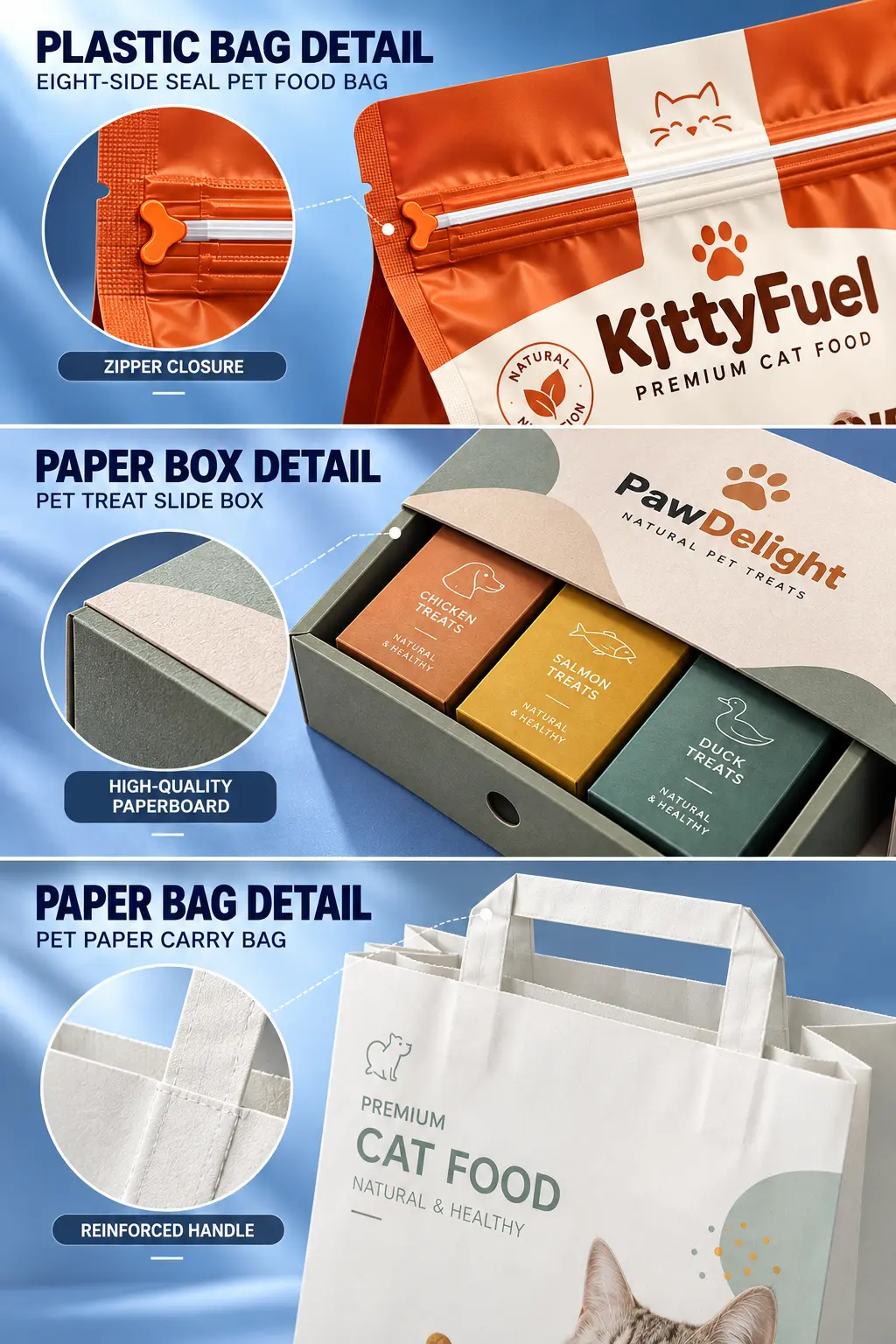
Flat-bottom or eight-side-seal bags offer defined panels and an upright retail presentation. They may suit dry dog or cat food products where a stable pack, printable front and side panels, and suitable closure options matter. The finished dimensions and film strength still need to match the actual fill volume, kibble shape and transport conditions.
For a relevant product example, see UNIPACK’s custom eight-side seal cat food bags. The listed design supports customized bag dimensions, side gussets, resealable closure options and different laminated film structures; it is a format example, not a universal material prescription.

Stand-Up Pouches for Treats and Smaller Retail Packs
Stand-up pouches can work well for freeze-dried treats, small snacks and other products sold in repeat-use packs. A resealable zipper may improve convenience after opening, while tear notches can simplify the first opening. Any clear window needs to be considered alongside the product’s light, oxygen and moisture sensitivity.
UNIPACK’s custom pet treat stand-up pouches illustrate printed resealable pouch options for pet snacks and treats. For moisture-sensitive products, ask the supplier to evaluate the complete film and window structure before committing to an attractive but untested design.

What a Pouch Alone May Not Solve
A flexible bag does not always supply the rigid presentation desired for a gift set, sampling kit or grouped retail assortment. It may also need a suitable outer shipping case for distribution. Think of the pouch as a possible product-protection solution, not as a replacement for every other packaging function.
When Do Folding Cartons Make More Sense?
Folding cartons are useful when a pet brand needs a defined retail shape, broad printed panels or a neat way to organize inner packs. Printed paperboard can support premium positioning, variant identification, instructions and shelf presentation without requiring the carton to perform every protective function.
Common applications include boxed dog treats, sampler assortments, sealed sachets sold as a set, small pet supplement retail kits and promotional bundles. Structure choices may include tuck-end cartons and other die-cut folding formats, depending on the assembled weight and shelf arrangement.
See UNIPACK’s custom pet food folding cartons for paperboard and printing examples. The product page lists SBS, coated and kraft paperboard options with customized structural and finishing choices. The intended contact condition, if any, must still be checked for the actual project.

Before selecting a carton, ask whether it needs to hold a sealed pouch, several small packs or an insert. Then specify board grade, dimensions, closure style and expected handling conditions. A delicate retail carton should not automatically be treated as a heavy-duty shipping case.
When Is a Pouch-and-Carton Combination Better?
Combining formats is useful when each layer has a distinct purpose. The inner pack is specified for product containment and protection; the outer carton is specified for grouping, retail design and handling. Adding a box only for appearance may increase cost and packaging waste without improving the user experience.
Scenario 1: Premium Treats in a Sealed Inner Pouch
A brand selling delicate or aromatic treats may need a sealed inner pouch with suitable barrier properties. A printed outer folding carton can provide the premium shelf look and additional surface for artwork or information. Check how the pouch fits inside the carton, whether a window or insert is needed, and how the customer will remove the inner pack.
Scenario 2: Individually Packed Treats in a Retail Box
A sample kit or multipack may contain several separately sealed treat portions. In this case, the carton organizes individual units and gives the buyer a consistent presentation. The seal and material requirements belong to the individual primary packs, and the entire set needs adequate space for required product information.
Scenario 3: Mixed Pet Product Sets
Mixed-format promotions can combine several protected units in a single branded carton. The project should account for differences in unit dimensions, puncture risk, friction and movement during transit. A folding paperboard box may be suitable for retail display, while another protective shipper may still be needed for e-commerce deliveries.
Materials and Barrier Performance: Check Function Before Finish
For dry food and treats, a film’s protective performance can matter more than its appearance. Oily kibble may be sensitive to oxygen exposure; crisp or freeze-dried snacks may be sensitive to moisture pickup. The required level of protection depends on the actual formulation, intended shelf life, storage conditions and filling process.
- Oxygen barrier: Ask whether an oxygen-transmission target (OTR) is needed for the product. High-fat items may require closer attention to oxidation.
- Moisture barrier: Water-vapor transmission (WVTR) can be particularly important when texture and dryness matter.
- Seal integrity: Material choices must work with the intended sealing method. Grease, crumbs, powder and filling speed can affect the sealing area.
- Durability: Evaluate puncture, drop and handling risks for sharp kibble, heavy fills and e-commerce distribution.
UNIPACK lists laminate options such as PET/PE, PET/VMPET/PE and PET/AL/PE for its eight-side-seal cat food bags. These are options to evaluate, not interchangeable guarantees of shelf life. Confirm the selected construction, relevant test results and compatibility with the finished food before placing an order.
For a closer comparison of film structures, barrier performance and recycling considerations, see our mono-material vs multilayer packaging guide.
Paperboard selection follows different criteria: board stiffness, fold performance, printing requirements, handling conditions and whether a functional inner pack is used. SBS, coated paperboard and kraft paperboard can offer different display characteristics, but a paper surface or attractive finish alone does not prove adequate food protection.
Match the Packaging to the Pet Product and Sales Channel
Use this planning matrix to start supplier discussions. Actual dimensions, material grades and performance requirements must be established through the product brief and samples.
| Pet product or sales goal | Format to explore | Priority checks |
|---|---|---|
| Dry dog or cat kibble | Sealed flat-bottom or other suitable flexible bag | Fill weight, seal strength, oxygen exposure and handling |
| Freeze-dried treats | Stand-up pouch; optional retail carton | Moisture protection, product fragility and resealability |
| Mixed treat sampler | Individual sealed portions inside a folding carton | Inner-unit seals, grouping, labeling and pack-out |
| Premium retail bundle | Suitable primary packs plus branded outer carton | Retail appearance, added material cost and protection in transit |
| Wet or heat-processed pet food | Specialized validated primary pack; carton only if useful as an outer pack | Process compatibility and documented safety/performance validation |
For wet products, never assume that a standard pouch designed for dry food is suitable for retort processing. Thermal-processing requirements, seal systems and product safety need to be assessed separately with qualified manufacturing and packaging partners.
Five Practical Buying Decisions Before You Approve Artwork
1. Specify the Product and the Actual Fill
Describe the product form, approximate fill weight, bulkiness, sharp edges, oil content and sensitivity to moisture. Two products with the same net weight may need different packaging dimensions, so actual fill trials are more useful than choosing size by weight alone.
2. Confirm How the Pack Will Be Filled and Sealed
Indicate whether you use manual filling, premade-pouch equipment or form-fill-seal equipment. Share the relevant machine constraints before finalizing openings, zipper positions, rollstock or finished pouch specifications.
3. Check the Opening and Reclosing Experience
Decide whether the buyer needs a tear notch, resealable zipper or single-use format. Closure details should match the product, shelf environment and how frequently the pack is likely to be opened.
4. Design for Where the Product Will Be Sold
Retail shelves reward visible branding and stable packs, while mail-order shipments may impose additional compression and drop stresses. A printed retail carton and a shipping carton are not automatically interchangeable.
5. Calculate the Complete Packaging System
Compare the cost and practical value of the entire configuration rather than one bag or box in isolation. Include inner and outer materials, packing steps, shipping volume, damage risk and the ability to manage artwork across SKUs. The cheapest individual component is not always the most economical system.
What Should a Pet Food Brand Include in a Packaging RFQ?
A clear request for quotation (RFQ) helps a packaging supplier recommend relevant options without making assumptions. Include the following wherever known:
- Product description: dry kibble, baked biscuit, freeze-dried treat, powder or another format; any important sensitivity.
- Packaging role: primary/direct-contact pack, retail secondary carton or both; specify any sealed inner units.
- Target pack size: approximate net fill, preferred width/height/gusset and the actual product volume.
- Protection needs: desired shelf life, storage conditions and any established oxygen or moisture barrier targets.
- Filling details: manual or automated filling, machine type, sealing and handling requirements.
- Functional features: zipper, tear notch, window, inserts, hang hole or other relevant options.
- Printing and market: artwork status, color/finish preferences, destination market and applicable labeling review.
- Commercial details: estimated order quantity, SKU count, sample needs and target launch schedule.
For a pouch-and-carton combination, share both the inner-pack and outer-carton requirements. Request physical samples and confirm the final construction and printed artwork before production.
What About Recyclability and Pet Food Labeling?
Sustainability should be evaluated for the complete package, not just whether one component looks like paper. A carton with a liner, plastic window or lamination may have different disposal routes from an uncoated carton. Likewise, the recyclability of a flexible pouch depends on its specific construction and available local collection systems.
For products entering the European Union, brands should check the current European Commission guidance on packaging and packaging waste as part of their regulatory review. For products sold in the United States, the U.S. FDA’s animal food labeling guidance explains federal pet food labeling requirements and the role of state rules.
Those resources are references for brand compliance teams, not proof that any particular UNIPACK material or printed design is compliant. The brand and relevant specialists should confirm product-specific requirements, permitted claims and supporting documentation for each destination market.
Frequently Asked Questions
Are pouches better than cartons for dry pet food?
Neither format is universally better. A suitable sealed pouch is often the first choice for the primary pack because its material and seal can be specified for the product. A folding carton may provide additional retail presentation or grouping when the inner pack is already defined.
Can pet treats be packaged directly inside a paperboard carton?
Possibly, but not by assumption. The carton, coatings, inks, adhesives and intended use need review for direct-contact suitability and the product’s protection needs. Many projects instead use a sealed inner pouch or individually packed portions.
Do freeze-dried pet treats need a high-barrier pouch?
Moisture control is often an important consideration for freeze-dried treats. The necessary film structure and barrier level should be decided using product characteristics, desired shelf life, storage conditions and appropriate validation rather than a generic material claim.
When is an inner pouch plus outer carton worth the extra packaging?
It may be worth evaluating for premium boxed treats, multi-SKU assortments, gift-oriented packaging or separately sealed portions. The benefits in branding and handling should justify added cost, pack-out steps and material use.
What details help a supplier give an accurate custom packaging quote?
At minimum, provide the product format, approximate fill weight, intended primary/secondary packaging role, required size, filling method, artwork status, estimated quantity and destination market. Share barrier requirements and any inner-pack details if available.
Choose the Packaging System That Fits the Product
The best packaging decision begins with the product, not the outer appearance. Use a suitable flexible pouch when containment, protection and convenience are central. Choose a folding carton when printed presentation, grouping or retail structure adds value. Combine them only when the extra layer has a clear purpose.
Planning a custom pet food or pet treat packaging project? Explore UNIPACK’s custom pet food packaging options or send your packaging requirements to our team. Tell us what you are packing, how it will be sold and whether you need pouches, cartons or a coordinated system. We can discuss suitable structures and sampling based on your project brief.
Still comparing flexible pouches, folding cartons, or a combination for your pet food brand? Stay connected with UNIPACK on Instagram and Facebook as you explore your packaging options. You can also visit our official YouTube and TikTok channels for more ways to connect with our team.